
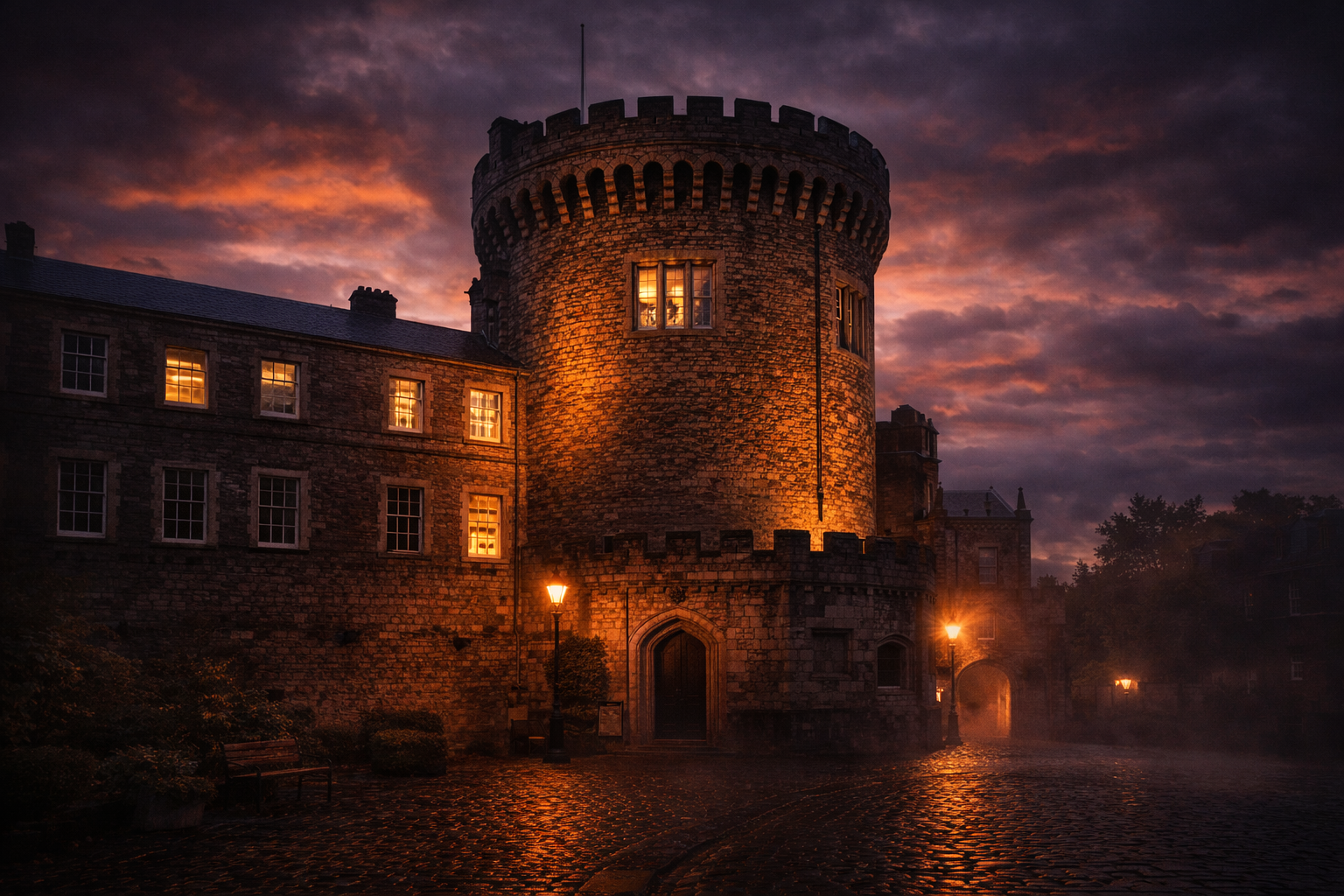
Dublin Castle's medieval survivor
Lower Castle Yard
c. 1228 - 1230
Norman Medieval
Rising from the southeastern corner of Dublin Castle, the Record Tower is the only substantial remnant of the original medieval fortress. Dating from around 1230, this circular tower has stood watch over Dublin for nearly 800 years, surviving fires, sieges, and centuries of transformation that swept away the rest of the Norman castle.
When King John ordered the construction of Dublin Castle in 1204, he commanded that it be built "with good and strong walls and good ditches for the defence of the city." The result was a classic Norman fortress, roughly rectangular in plan, with a circular tower at each corner and a strong gatehouse.
The Record Tower was one of these corner towers. Built of local limestone, its walls are approximately 16 feet thick at the base, tapering as they rise. The tower originally stood about 50 feet tall, though the current battlemented top is a 19th-century addition designed to give it a more "medieval" appearance.
The tower gets its name from its later use as a repository for government records. From the 17th century onwards, the tower housed the records of the Irish Chancery and other administrative documents. Its massive walls and relative isolation from the rest of the castle complex made it ideal for protecting valuable papers from fire.
These records documented centuries of Irish history — land grants, legal proceedings, administrative correspondence — providing an invaluable resource for historians. Sadly, many of these documents were later transferred to the Four Courts, where they were destroyed in the fire of 1922.
Before becoming a record repository, the tower served a grimmer purpose as a prison for political detainees and prisoners of high status. Its thick walls and small windows made escape virtually impossible, while its location within the castle complex ensured constant surveillance.
Among those imprisoned here was Red Hugh O'Donnell, the young Gaelic lord who was kidnapped and held in the tower in 1587. His dramatic escape on Christmas night 1591 — climbing down a privy shaft and fleeing through the snow to the Wicklow Mountains — became one of the great legends of Irish resistance.
In the 19th century, the Record Tower underwent significant restoration. The battlements were rebuilt in a romanticized medieval style, and the tower was incorporated into the new Chapel Royal, which was built adjacent to it. A connecting passage was created, allowing access between the two structures.
Today, the Record Tower can be glimpsed from the Lower Castle Yard and from the Dubhlinn Gardens. While the interior is not regularly open to the public, archaeological excavations in the undercroft beneath the chapel have revealed fascinating insights into the original medieval castle and the Viking settlement that preceded it.
The Record Tower stands as a tangible link to Dublin's medieval past. In a castle complex dominated by Georgian architecture, this ancient tower reminds us that Dublin Castle began not as a elegant palace but as a military fortress, designed to project English power into the heart of a conquered city.
Its survival through centuries of change is remarkable. While fires destroyed the rest of the medieval fabric, while Georgian architects remodeled the upper castle, while independence transformed the castle's meaning, the Record Tower endured — a silent witness to 800 years of history.