
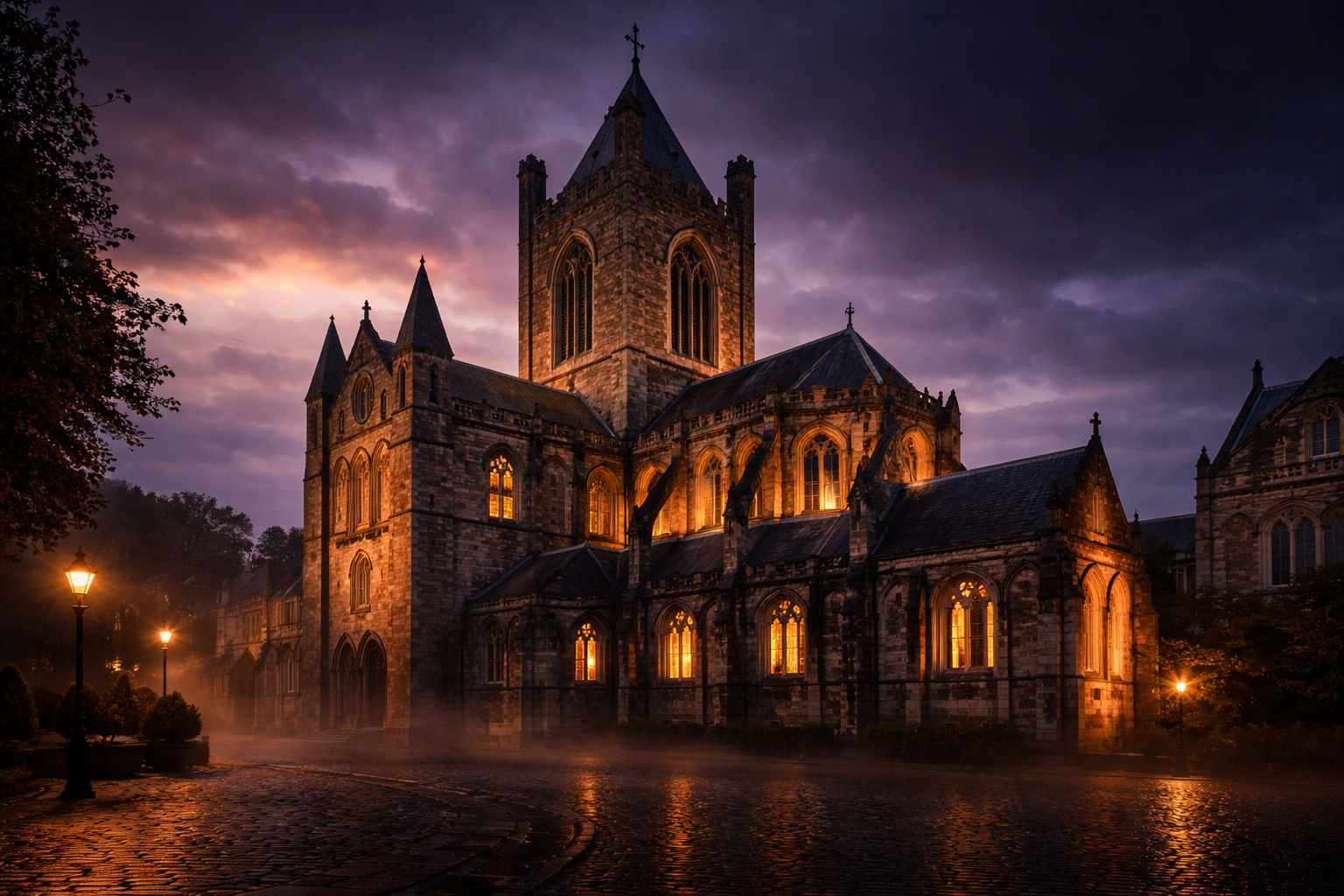
A millennium of faith and history
Christchurch Place, Dublin 8
c. 1028
Medieval Gothic
Christ Church Cathedral is Dublin's oldest building still in daily use and the spiritual heart of the city for nearly a thousand years. Founded in 1028 by Sitriuc, the Viking King of Dublin, this magnificent Gothic cathedral has witnessed every major event in Irish history and remains an active place of worship to this day.
In 1028, Sitriuc Silkenbeard, the Norse King of Dublin, founded a wooden church on this site, dedicating it to the Holy Trinity. This was a remarkable act for a Viking ruler — a signal that the Norse settlers of Dublin had embraced Christianity and sought to establish their city as a center of faith and learning.
The first bishop, Dúnán (Donatus), was appointed in 1028, establishing a tradition of episcopal leadership that continues to this day. The cathedral would serve as the seat of the Archbishop of Dublin for centuries, though today it is the cathedral of the Church of Ireland's Dublin and Glendalough diocese.
Following the Norman invasion in 1170, Richard de Clare (Strongbow) and Archbishop Laurence O'Toole began construction of a grand stone cathedral to replace the original wooden structure. The building we see today dates largely from this period, though it has been extensively modified and restored over the centuries.
Strongbow himself was buried in the cathedral in 1176, and his tomb (or a later replacement) remains one of the cathedral's most famous features. Beside it lies a smaller effigy, traditionally said to be his son, whom legend claims Strongbow killed for cowardice in battle.
Beneath the cathedral lies one of the oldest and largest crypts in Ireland and Britain. Dating from the 12th century, this atmospheric underground space stretches the entire length of the cathedral and houses a fascinating collection of historical artifacts.
Among the crypt's treasures are the mummified remains of a cat and rat, discovered in an organ pipe in the 1860s — the cat apparently having chased the rat into the pipe where both became trapped. This macabre pair has become one of the cathedral's most beloved curiosities, immortalized by James Joyce in "Finnegans Wake."
By the 19th century, Christ Church had fallen into serious disrepair. In 1871, the whiskey distiller Henry Roe funded a complete restoration of the cathedral, overseen by architect George Edmund Street. While controversial — Street's work was sometimes criticized for imposing Victorian interpretations on medieval fabric — the restoration undoubtedly saved the cathedral from collapse.
Street also designed the covered bridge connecting the cathedral to the Synod Hall, creating one of Dublin's most distinctive architectural features. The Synod Hall now houses Dublinia, an interactive exhibition on Viking and medieval Dublin.
Christ Church Cathedral welcomes visitors of all faiths and none. You can explore the nave with its soaring Gothic arches, descend into the ancient crypt, and discover treasures like the 12th-century Romanesque doorway and medieval floor tiles. Regular services continue to be held, and the cathedral choir maintains a tradition of choral music dating back centuries.
The cathedral also hosts concerts, exhibitions, and special events throughout the year. Standing at the heart of medieval Dublin, just a short walk from Dublin Castle, Christ Church offers an unparalleled journey into the spiritual and architectural history of the city.